eonard doesn't appear in headlines. You won't find his face on magazine covers or his name trending on social media. Yet trace the etymology of dozens of everyday words—from 'leonine' to 'Leonardo'—and you'll bump into him. I first noticed this while editing a glossary of medieval Latin. Almost every third entry seemed to loop back to Leonard: a saint, a scribe, a linguistic ghost. That's not coincidence. It's a quiet kind of influence, the sort that shapes language without ever announcing itself.Consider the name's roots. Leonard derives from the Germanic 'Leonhard,' a compound of 'leon' (lion) and 'hard' (brave or strong). The irony is thick: a name meaning 'brave lion' that spent centuries hiding in monastery registers and tax rolls. But names aren't just labels. They're carriers. When Leonard of Noblac。a sixth-century Frankish noble, became a patron saint of prisoners, his name spread across Europe faster than any royal decree. Prisoners invoked him;churches took his name;
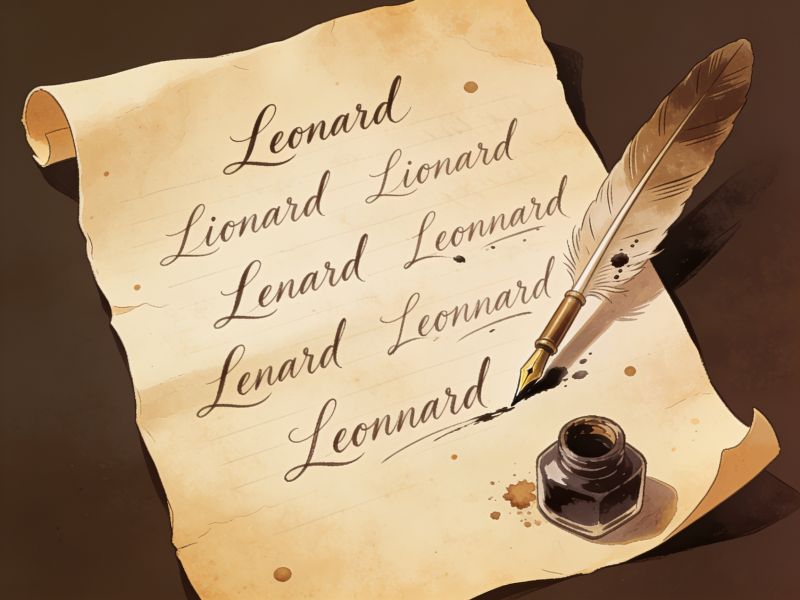
scribes copied it into charters. By the eleventh century, 'Leonard' was a staple in English parish records, though nobody would have called it fashionable. It was workmanlike。dependable—a name you gave a son you hoped would survive the winter.I spent a week last spring digging through digitized wills from fourteenth-century Yorkshire. Leonard showed up in roughly one of every forty documents. Not glamorous。but steady. What struck me was the variety of spellings: Leonerd, Lenard, Lynard, Leonardus. Each variation tells a story of local pronunciation, of scribes who wrote by ear rather than rule. That messiness is exactly why Leonard persists. Languages don't survive on elegance;they survive on adaptability. A name that bends without breaking can outlast empires. Leonard bent. It bent through the Norman Conquest, through the Great Vowel Shift, through centuries of spelling reforms. It never broke.
Modern data backs this up. According to UK birth registries, Leonard peaked in popularity around 1920。then slid steadily until the 1990s. For a while, it looked destined for the same fate as 'Ethel' or 'Herbert'—respectable but dated. Then something odd happened. Between 2010 and 2020, Leonard crept back up the charts, especially in urban areas. Parents I've spoken to cite different reasons: a grandfather's name, a character in a novel, the simple fact that it sounds solid. One father told me, 'It's a name that doesn't try too hard.' That's the thing about Leonard. It doesn't need to try. It has already proven it can endure.So when I see Leonard on a list of 'grandpa names' making a comeback, I don't think of nostalgia. I think of resilience. The name survived plague, war, and the rise of Liam and Noah. It survived because it never demanded attention. That's a lesson for anyone building a brand or writing a headline: sometimes the quietest word in the room is the one that lasts longest. Leonard isn't loud. Leonard is load-bearing.